What Went Right, What Went Wrong, and What I Wish I’d Known
Disclosure: This post contains affiliate links. If you purchase through these links, I may earn a small commission at no additional cost to you.
When summer sports camp registration opened, my son was all in.
This wasn’t just any camp.
This was ice skating camp.
The first step on his journey to becoming a hockey player.
At least in his mind.
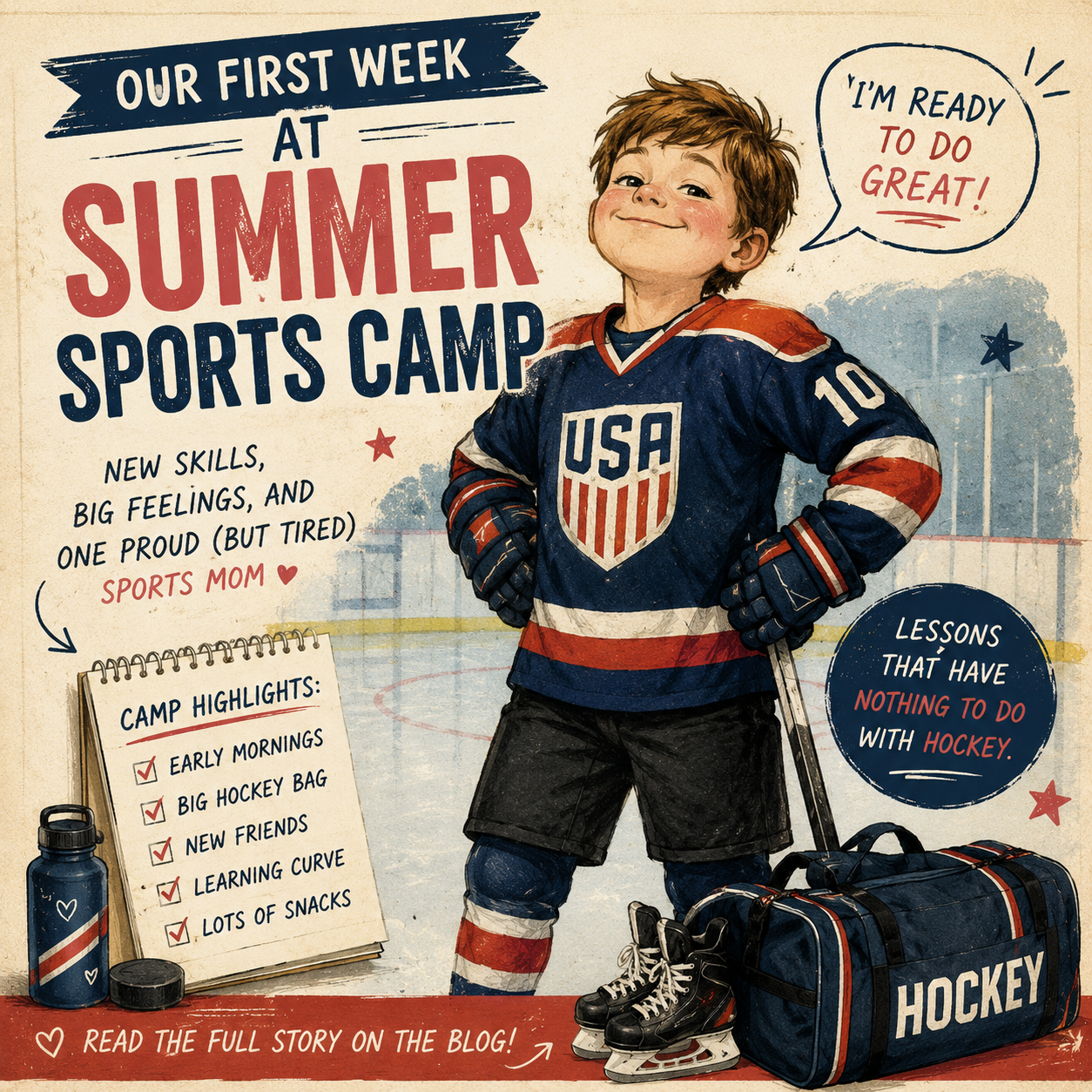
He’s been talking about hockey for months. He owns a Mighty Ducks jersey. He watches hockey clips. He practices in the driveway. If confidence alone could get you drafted, he’d already have a professional contract.
So when I told him he was going to hockey camp, he was equal parts excited, nervous, and anxious.
Mostly excited that there was no school.
As far as he was concerned, camp meant spending all day having fun.
As far as I was concerned, camp meant surviving the packing list.
The Packing List That Nearly Defeated Me
A few days before camp, we got the official list.
I looked it over once.
Then I looked it over again.
Then I started gathering supplies.
By the time I finished packing, I was pretty sure we could survive a long weekend in the wilderness.
Inside his bag:
✔ Skates
✔ Helmet
✔ Cold-weather clothes for the ice rink
✔ Extra clothes
✔ Swimsuit
✔ Towel
✔ Snacks
✔ Things I can’t even remember anymore
I honestly think the camp bag was fuller than the bag we took on our last family trip.
The funny part?
The things I worried about weren’t the things that ended up mattering.
Day One: Confidence Levels Were High
Drop-off went surprisingly well.
No tears.
No hesitation.
No dramatic goodbye.
He practically sprinted into camp.
I stood there wondering if I should be emotional.
Meanwhile, he was already gone.
That’s when I realized something important:
Kids adapt a lot faster than parents do.
What I Wasn’t Prepared For
I knew he’d be skating.
I knew he’d be active.
I knew he’d be learning new skills.
What I wasn’t prepared for was how absolutely exhausted he would be.
Every afternoon looked the same.
He’d climb into the car.
Tell me camp was amazing.
Eat approximately half the groceries in our house.
Then immediately become the world’s most tired five-year-old.
The exhaustion hit hard.
And with exhaustion came something else.
Frustration.
The Hard Part Nobody Talks About
My son likes being good at things.
Don’t we all?
The problem is that in his mind, he wasn’t joining a beginner skating camp.
He was already a hockey player.
After all, he owns a Mighty Ducks jersey.
That’s practically professional-level experience.
At least according to him.
The reality was a little different.
There were skills he didn’t know yet.
Techniques he’d never tried.
Kids who had skated longer than he had.
And for the first time, he started realizing that wanting to be good at something and actually being good at it are two very different things.
That realization led to some tough conversations.
There were moments when he got frustrated.
Moments when he wanted things to come easier.
Moments when he wondered why other kids seemed better.
As parents, those moments are hard to watch.
You want to fix it.
You want to tell them they’re amazing.
You want to make the disappointment disappear.
But sometimes growth happens right in the middle of those uncomfortable feelings.
The Wins That Didn’t Show Up on the Ice
By the end of the week, his skating had improved.
That part was obvious.
But the biggest victories weren’t about skating.
He learned how to keep trying when something felt hard.
He learned that mistakes don’t mean failure.
He learned how to work with teammates.
He made new friends.
He learned that everyone starts somewhere.
And maybe most importantly, he learned that being the best isn’t the only thing that matters.
Now don’t get me wrong.
He’s still almost six.
There were definitely moments when he wanted to be the best.
There were moments when losing felt unfair.
There were moments when his confidence was a little bigger than his current skill level.
But that’s part of being a kid.
And honestly?
That’s part of learning.
What I’d Do Differently Next Time
If I could go back and talk to myself before camp started, here’s what I’d say:
Pack the snacks.
Bring the water bottle.
But most importantly?
Prepare for the emotions.
Because sports camp isn’t just about learning a sport.
It’s about learning confidence.
Patience.
Perseverance.
Teamwork.
And sometimes learning that you won’t master something on the first try.
What Went Right
✔ He had fun.
✔ He made friends.
✔ He learned new skills.
✔ He gained confidence.
✔ He wanted to go back every day.
What Went Wrong
✔ I underestimated how tired he’d be.
✔ I underestimated how emotional learning something new can feel.
✔ I thought the challenge would be packing the bag.
Turns out the challenge was helping him navigate disappointment and frustration when things didn’t come easy.
What I Learned
At the beginning of the week, I thought hockey camp was about skating.
By the end of the week, I realized it was about something much bigger.
It was about watching my son do something hard.
Watching him struggle.
Watching him improve.
Watching him keep going.
And honestly, I couldn’t have been prouder.
Not because he became the best skater.
Not because he won anything.
Not because he mastered every skill.
But because he showed up every day and tried.
For a kid who’s almost six, that’s a pretty big win.
Keep Reading
👉 Essential Tips for Youth Sports Parents
👉 The First Time My Son Went Fishing (And Apparently Became a Professional Overnight)
👉 How We Accidentally Became a Golf Family
👉 At-Home Sports, Backyard Chaos, and the Ones That Actually Tire My Kid Out
Tell Me
What’s something your child tried that was harder than they expected?
I’d love to hear your stories because I have a feeling we’re all figuring this out together.